
- The Blueroom Project surveyed more than 200 tourism professionals across Spain, Portugal and Latin America, with the support of the Tourism & MICE Communications alliance and the special collaboration of Capital Marketing and Jervis.
- The study identifies a Generation X traveller who travels as a couple or with family and seeks purposeful leisure experiences rather than luxury for its own sake.
- 71.1% of the highest-value clients travel primarily for leisure, while gastronomy-focused trips (50.6%) and slow tourism (41.6%) are gaining the most momentum.
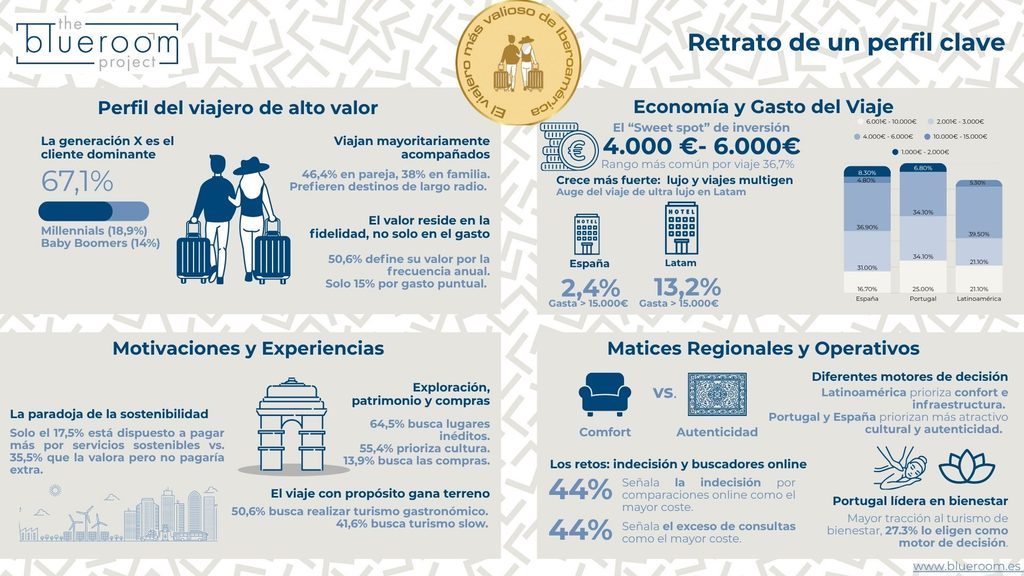
The Blueroom Project has presented The Most Valuable Traveller in Ibero-America, an international study conducted in July 2026 among more than 200 tourism professionals from Spain (50.6%), Portugal (26.51%) and Latin America (22.89%). Of those surveyed, 92.8% work in DMCs, tour operators or travel agencies. Developed through the alliance with Tourism & MICE Communications and with the special collaboration of Capital Marketing and Jervis, the study reaches a clear conclusion: the industry’s most valuable customer is not the one who spends the most on a single trip, but the one who returns most often.
Loyalty Matters More Than Occasional High Spending
For 50.6% of respondents, the key factor that defines a valuable customer is how frequently they travel each year, while only 15.1% associate value primarily with high trip expenditure. In addition, 66.3% consider the most operationally profitable profile to be the “loyal customer”, compared with just 9.6% who prioritise a low-maintenance, autonomous traveller.
Portugal places the greatest emphasis on loyalty (68.2%), ahead of Spain (50%) and Latin America (31.6%), where personalised experiences stand out as the most important factor (52.6%).
A Generation X Profile Travelling as a Couple or Family
Generation X accounts for 67.1% of the highest-value clients, followed by Millennials (18.9%) and Baby Boomers (14%), while Generation Z barely features in the results.
These travellers most commonly travel as a couple (46.4%) or with family (38%), and tend to favour long-haul travel (45.8%) or a combination of short-, medium- and long-haul trips (35.5%).
The Sweet Spot: €4,000 to €6,000
The most common per capita spend is between €4,000 and €6,000 (36.7%), with bookings typically made two to five months in advance (68%).
Ultra-luxury travel (more than €15,000 per person per trip) is growing strongly in Latin America, where it reaches 13.2% of respondents, compared with just 2.4% in Spain.
Purpose-Driven Leisure: Gastronomy and Slow Tourism
Some 71.1% of high-value clients travel primarily for leisure purposes. Gastronomic travel, identified as a growing trend by 50.6% of respondents, and agritourism or slow tourism (41.6%) are the segments gaining the greatest traction.
When choosing a destination, travellers are driven above all by the desire to discover new places (64.5%), followed by heritage and museums (55.4%) and gastronomy (50.6%).
The Sustainability Paradox
Only 17.5% of respondents believe that customers are increasingly demanding sustainability and are willing to pay extra for it.
A further 35.5% value sustainability but would not pay a premium, while 34.3% would only consider it if it does not increase the overall price.
In Summary
According to Alejandro Pérez-Ferrant, Founder and CEO of The Blueroom Project, the study concludes that:
“The high-value Ibero-American traveller is a Generation X profile characterised by loyalty and repeat travel, rather than occasional high spending. They travel as a couple or family, seeking purposeful leisure experiences such as gastronomy, culture and nature rather than luxury for its own sake, with trip expenditure consistently concentrated in the €4,000 to €6,000 range.”
From a regional perspective, Spain stands out for its market maturity and long-haul travel focus; Portugal leads in long-term customer loyalty and wellness tourism; while Latin America is driving stronger growth in ultra-luxury travel, comfort-driven demand and bleisure travel.
(*) Reproduction of the study, in whole or in part, is prohibited unless the source is explicitly credited.