OUR APPROACH
BeingBlueroom
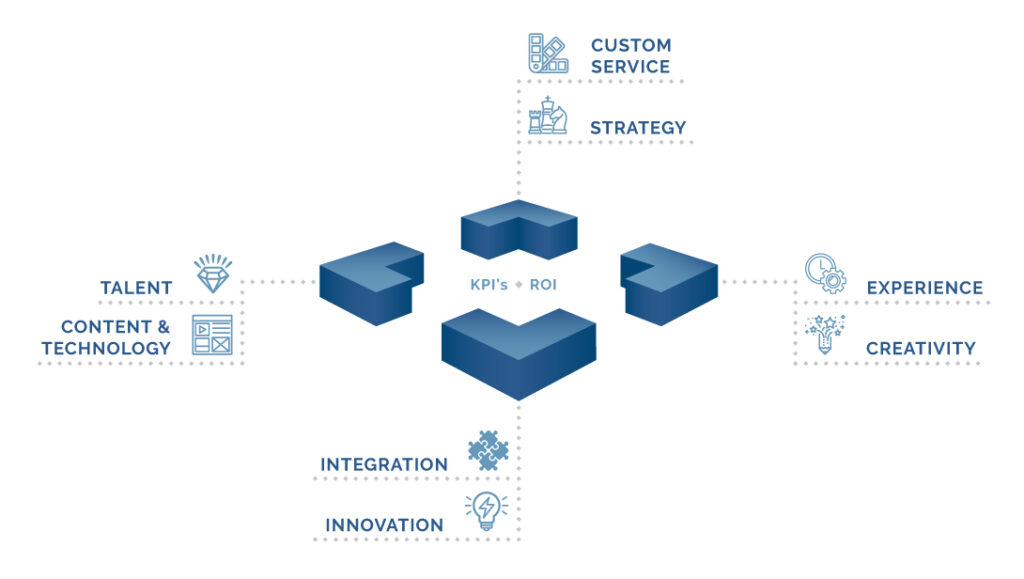
Our formula: Lab & Consultancy
Rooms have four corners; at Blueroom we have four angles of cross-analysis.
- Global thinking with a local focus.
- A strong network across tourism, media and influencers.
- An expert and creative team specialising in integrated campaigns.
- Measurable results and long-term relationships.
The New Paradigm
The New Strategic Theory (NST – NTE in Spanish) developed by Rafael Alberto Pérez puts forward a fundamental idea:
- Strategy is not a closed plan.
- Communication is not merely a tool.
- The objective is not impact, but the shared construction of meaning.
Applied to tourism, this requires a profound rethinking of how destinations and tourism brands are designed, communicated and activated.
For years, tourism marketing has focused on promoting attractions, differentiating products and generating visibility. However, the context has changed.
Today’s travellers are better informed, more critical, and increasingly seek wellbeing, authenticity, coherence and purpose.
Destinations —and brands— no longer compete solely to attract visitors, but to build lasting and legitimate relationships, where the wellbeing of local communities is as important as that of the visitor.
For us, communication is a true strategic action: it shapes perceptions before the journey, accompanies the experience during the stay, and endures afterwards through shared storytelling. Beyond immediate visibility or impact, we aim to build meaningful positioning aligned with the values, culture and reality of each destination or organisation.
We understand tourism marketing and communication as a living, relational and profoundly human process. We do not work with “targets”, but with people; we do not design isolated campaigns, but coherent narratives built over time that generate meaning, value and trust.
From this perspective, tourism destinations and brands are complex systems made up of multiple stakeholders —travellers, residents, businesses, institutions and communities— whose relationships define their identity, reputation and future. That is why our approach always starts with listening, deep contextual understanding and genuine involvement in every project.
We embrace the complexity of the tourism sector and the need to adapt to a constantly changing environment (globalisation, geopolitics, crises, natural disasters, and more), combining strategic vision, flexibility and coherence. We are committed to long-term relationships, authenticity over standardised messaging, and a real balance between measurable results and intangible value: differentiation, legitimacy and relevance.
We believe that today destinations and brands are not chosen only for what they offer, but for what they represent. That is why we help tell stories that connect with people, respect territories and build tourism brands with meaning —capable of lasting over time.
Our Model
No tourism expert has a crystal ball to predict the future. Not even data-driven approaches can fully capture it, as the environment evolves at high speed, shaped by constant uncertainty and the volatility of people’s moods when planning, making consumption decisions, or even responding to surveys. What we do know, however, is how to face the future with greater certainty: it is time to live strategically.
We combine strategy, experience, innovation and creative execution, supported by continuous monitoring and optimisation to deliver measurable results.
Cooperation vs Confrontation
Quality vs Quantity
Productivity vs Reactivity
It is time to design the new tourism strategies for the next 5, 10 and 15 years. Strategy is a biological phenomenon and, as such, a natural one, not something we simply add artificially.
A lack of anticipation leads to lost opportunities.
We must not only become more efficient; we must also reflect on our tourism product: what we are going to offer, how we will present it to potential visitors, and how we will engage and inspire them.
We are what we choose: what we decide to do, or not to do (in a strategic sense), determines our future.
#Beingblueroom, A Different Way Of Understanding Tourism Marketing
Strategy is born of imagination and must generate surprise and disruption. Yet it is also grounded in calculation and structured through planning. It is better (and easier and more controllable) to change ourselves —to improve our products and services— than to try to change others. It is better to transform the relationship than to attempt to change the other party.
Rafael Alberto Pérez
Classic approach
Superficial differentiation-
Promotion
-
Impact
-
Consumer
-
Campaign
-
Message
#BeingBlueroom
Meaningful identity-
Relationship
-
Meaning
-
Traveller persona
-
Process
-
Conversation
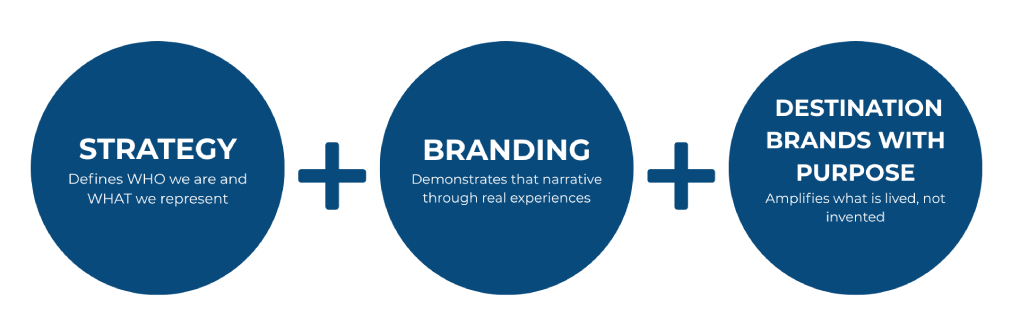
Strategy in contemporary tourism promotion must go beyond immediate tactical impact and mere aesthetic construction, and instead focus on the coherent integration of purpose, meaning and sense.
Blueroom